


Stolen Car Keys in London? How Key Erasure Helps Protect Your Vehicle

Could a stolen key still start your car, even after you’ve had it erased? It’s a reasonable concern. Car key erasure for stolen keys London may remove a key’s electronic authorisation, but whether that’s possible depends on your vehicle’s make, model, year and security system. Erasure also doesn’t necessarily stop the key from mechanically opening a door.
If your keys have been stolen, report the theft to the police, get a crime reference number and check with your insurer before arranging a replacement. You’ll also need to know how many keys remain and how to avoid being left without a working one during the process. This guide explains what erasure may change, what it can’t guarantee and what to ask before work begins. A mobile automotive locksmith can assess your vehicle and available keys on site, then discuss programming or replacement options, subject to compatibility and confirmation. We’ll also cover what information to share when arranging help in London.
Table of Contents
Stolen car keys in London: why erasure may be worth considering
If someone else has your car key, it’s sensible to act promptly and find out what access it could still provide. The stolen key won’t necessarily start or move your vehicle, but its capabilities depend on the car. Car key erasure for stolen keys London may be an option if your vehicle supports it. Available functions vary by make, model, year and security system.
Electronic key erasure removes a key’s authorisation from the vehicle’s security system, where supported. It doesn’t necessarily change the physical locks, so a compatible metal key blade could still open a door even if the key’s electronic credentials have been removed.
What does erasing a stolen car key mean?
A car may recognise credentials stored in a transponder key, remote fob or smart key. These credentials communicate with parts of the vehicle’s security system. An immobiliser, for example, is designed to prevent the engine starting unless the vehicle recognises an authorised key. Read more about how immobiliser technology works.
Electronic key erasure is the removal of a key’s electronic authorisation from a vehicle’s system, where supported. The process differs between vehicles. Depending on the system, a technician may be able to remove a particular key credential. Don’t assume every vehicle has the same functions or that erasure affects every way the key could provide access.
Why act promptly after a key is stolen?
The immediate concern is that an unauthorised person may have a key the car still recognises. Acting promptly gives you a chance to secure the vehicle and find out what your specific system supports. Erasure can’t guarantee protection from every form of access or theft.
While arranging advice, consider moving the vehicle to a secure location if you can do so safely. Keep any remaining keys with you, not inside or close to the car. Gather the vehicle’s make, model and year, and tell the specialist how many keys you still have. These details help establish whether erasure can be checked and whether replacement key programming may also be worth discussing. A vehicle-specific assessment matters because an option available for one model may not be available for another.
How car key erasure works, and what it cannot guarantee
Before considering changes to a vehicle’s key settings, a technician needs to establish what the car supports. The assessment starts with details such as the make, model and year, then considers the security system and available programming functions. This helps determine whether erasure is possible and whether other key programming options may be suitable.
There isn’t one procedure for every car. Manufacturers and models can handle stored key credentials differently, and the available tools and functions vary. Treat car key erasure for stolen keys London as a vehicle-specific question, not a guaranteed result simply because a key has been stolen.
Can the stolen key still open the door after deletion?
Possibly. Electronic starting authorisation and the mechanical action of a key blade are separate functions. Removing a credential from the vehicle’s system may affect whether the key can start the car, but it doesn’t necessarily change the physical door lock. Remote locking is another consideration: what happens to a stolen remote or fob depends on the vehicle and key type.
Ask the technician to explain exactly what deletion would change on your car. Don’t assume that a key which can no longer start the engine also cannot unlock the doors remotely or with its blade.
Will erasure affect the keys you still have?
It may. Depending on the vehicle, retained keys might need to be checked or re-authorised as part of the work. Gather every key you still have, including spare keys, and ask in advance whether they all need to be present. That helps clarify the plan and identify whether any available key needs attention.
Before agreeing to proceed, ask whether the stolen credential can be identified and removed, what will happen to the keys you bring, and how the result will be checked. No one should promise that every stolen key can be disabled without confirming the specific vehicle’s capabilities.
If the vehicle itself has also been stolen, rather than just its keys, use the official GOV.UK guidance on what to do if your vehicle has been stolen. For a key-related assessment, share your vehicle details and the number of keys you still have with Mr Unlocks’ mobile automotive locksmith service. Its confirmed options include car key programming and replacement, subject to vehicle compatibility. Ask specifically whether erasure is available for your make, model and year.
Key erasure, replacement, or dealer support: compare your options
After a key is stolen, consider two separate needs: addressing the missing key’s access and making sure you can still use your car. Erasure, replacement programming and manufacturer or dealer advice may each be relevant. The right route depends on the vehicle and what you need to resolve first.
When should you ask about erasing the stolen key?
Raise this early if an unknown person may have a key linked to your vehicle. Provide the make, model and year, then ask whether the system supports deleting the stolen key’s electronic credentials and how the result can be checked. A general assurance isn’t confirmation for your specific car. You can also ask the vehicle maker or your insurer whether they recommend additional steps.
When might replacement or dealer support be needed?
Replacement is relevant if the theft has left you without a working key, or you need another usable key alongside any security work. Programming may be possible, subject to compatibility and confirmation, but it is separate from erasure. For more background, see Car Key Replacement London: The Ultimate Guide (2026) and Car Key Programming London: The Expert Mobile Guide (2026).
A mobile automotive locksmith may be able to assess the vehicle and available keys on site. Share the vehicle details and how many keys remain, then confirm what can be done before arranging work. If the vehicle’s system calls for a manufacturer-specific procedure, dealer or manufacturer support may be appropriate. There isn’t one best option for every car. Choose based on the vehicle’s confirmed capabilities and whether your priority is addressing the stolen credential, restoring a working key, or both.
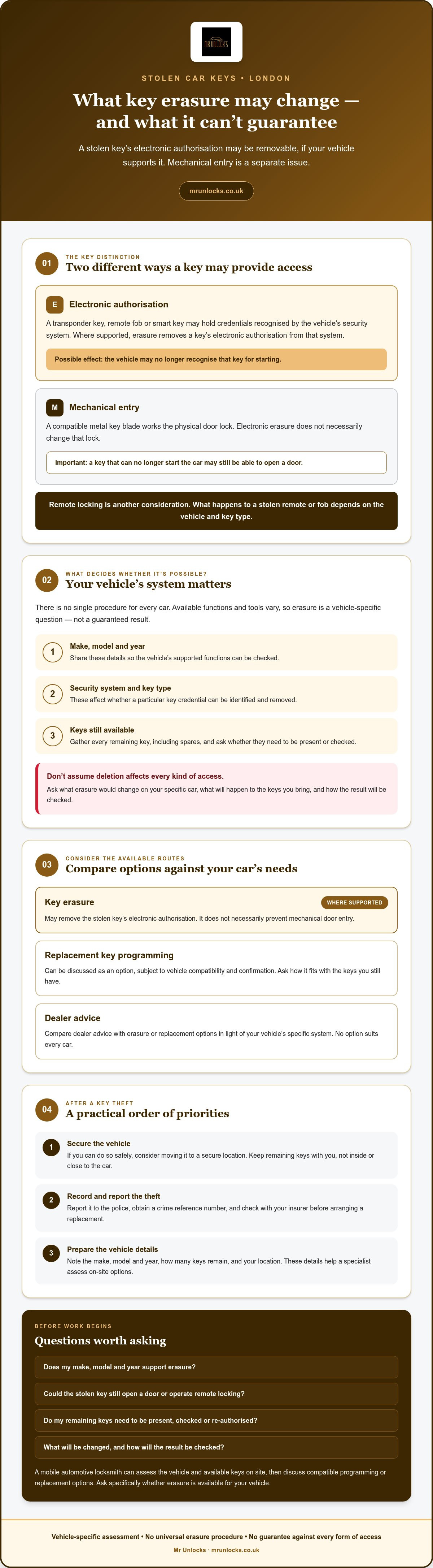
What to do after car keys are stolen in London
Take things in order: reduce immediate access to the vehicle, record what happened, then contact the appropriate people. You can start these practical steps before you know whether erasure is possible.
1. Secure the vehicle. If it’s safe and practical, move it to a secure location. Keep any remaining keys with you, rather than inside or close to the car. Remember that electronic key deletion may not prevent a compatible key blade from opening a lock.
2. Record the details. Write down when and where the key went missing or was taken, and what was stolen with it. Note the vehicle’s make, model, year, registration and current location.
3. Contact suitable support. Contact the police and your insurer where appropriate, and ask what information they need. Then speak to a vehicle-key specialist about whether your car supports erasure and which replacement or programming options may be available.
What information should you have ready?
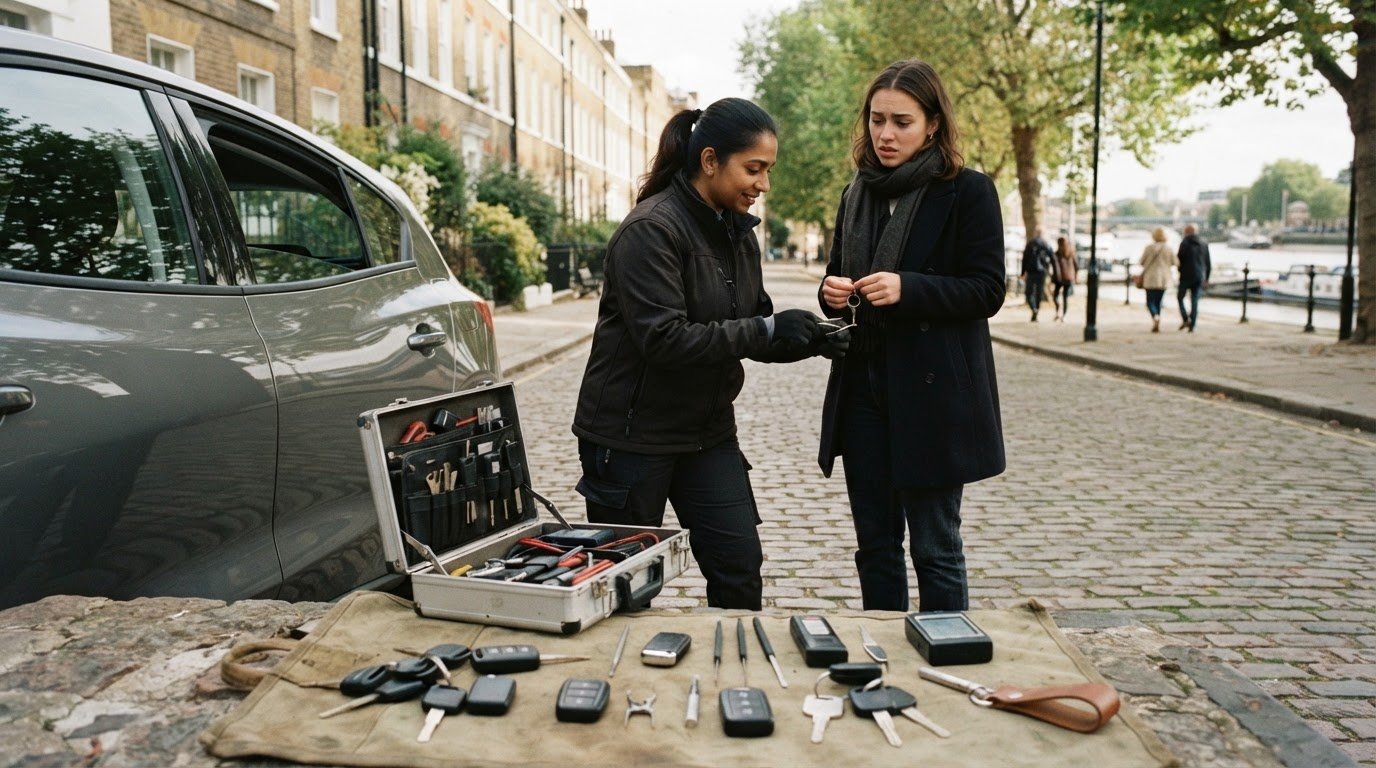
Be ready to describe the vehicle and explain where and when the key was taken. Count the working keys still in your possession and have them available if the technician asks to check them. Explain whether the stolen item was a remote fob, a key with an integrated blade or a separate key blade. These details help the specialist assess possible options without assuming every vehicle uses the same system.
How to arrange mobile help in South East London
Mr Unlocks is a mobile automotive locksmith serving areas including Lewisham, Bromley, Greenwich and Bexley. Coverage depends on your exact location, so confirm that a technician can attend before arranging a visit. Share the vehicle’s make, model and year, its location, and the number of keys you still have. Ask whether the vehicle can be assessed and whether erasure is supported for its specific security system. Car key programming and replacement are confirmed services, subject to vehicle compatibility and confirmation.
Need to discuss the options? Contact Mr Unlocks about your stolen car key with your vehicle and location details. If you’re also locked out, mention that when you enquire so the access issue can be considered separately.
Arrange vehicle-specific key help with Mr Unlocks in London
After a theft, get clear answers before arranging work. Mr Unlocks is a mobile automotive locksmith serving South East London and Kent, with confirmed services including car key programming, cutting, creation and replacement. Key erasure isn’t confirmed for every vehicle, so its availability needs to be checked for your specific car before it can be discussed as an option.
Give the technician enough information to assess the job before a visit is arranged. Have the vehicle’s make, model, year and location ready. Explain when and where the key was stolen, describe the key or fob, and say how many working keys you still have. This helps establish what may be possible and whether any remaining keys should be present for assessment or programming.
What to confirm before booking a mobile locksmith
Ask directly whether the technician can assess erasure for your exact make, model and year. Check whether all remaining keys need to be present and what will happen to them during programming work. If the vehicle doesn’t support deletion, ask what replacement or programming options may be suitable instead. Availability and results depend on the vehicle, so ask for the proposed work and its limitations to be explained before agreeing to proceed.
Get help with stolen car keys in London
Mr Unlocks provides mobile automotive locksmith support across South East London and Kent, including areas such as Lewisham, Bromley, Greenwich and Bexley. Confirm that your precise location is covered and that the vehicle can be assessed before arranging attendance. If you’re asking about car key erasure for stolen keys London, explain that you want the stolen key’s electronic authorisation considered, not just a replacement key.
Before work starts, ask what the technician expects to do, what the vehicle’s system allows and what the work won’t change. Electronic deletion may not prevent a compatible key blade from opening a door. A replacement key can restore a working option, but that alone doesn’t confirm the stolen key has been removed from the vehicle’s system.
Request vehicle-specific help from Mr Unlocks. Provide your location, vehicle make, model and year, the number of keys remaining, and a brief account of the theft. The team can discuss confirmed programming or replacement options and check whether erasure may be available for your vehicle.
Take the next step towards a secure replacement
A stolen key can’t always be erased from your vehicle. Available options depend on your car’s make, model, year and security system. Electronic deletion may not stop a compatible key blade opening the door, and a replacement key doesn’t confirm that the stolen key’s credentials have been removed.
For car key erasure for stolen keys London, ask for a vehicle-specific assessment before agreeing to work. Share your vehicle details, location, what happened and how many keys you still have. Mr Unlocks is a mobile automotive locksmith serving South East London and Kent, with confirmed services including car key programming, cutting and creation. Erasure availability needs to be checked for your particular vehicle. Emergency vehicle lock-out assistance is also available 24/7.
Contact Mr Unlocks to discuss your stolen car key and vehicle details. A clear assessment can help you understand the next suitable step and get back to using your vehicle with greater confidence.
Frequently Asked Questions
Can a stolen car key be erased from the vehicle?
A stolen key may be removable from a vehicle’s electronic security system if the car supports that function. A technician needs to check the make, model, year and security system before confirming. Erasure generally means removing the key’s electronic authorisation, but the procedure varies between vehicles. Ask whether the stolen credential can be identified and how the keys you still have will be handled.
Will erasing a stolen key stop it opening my car door?
Not necessarily. Erasure may affect the key’s electronic authorisation to start the vehicle, but it doesn’t automatically change the physical door locks. A compatible metal key blade could still open a door. Remote-locking behaviour also varies with the vehicle and key type. Ask what deletion would change on your specific car, including whether it affects remote functions as well as starting authorisation.
Can a locksmith erase a stolen car key in London?
A London automotive locksmith can check whether your vehicle supports key erasure, but don’t assume every locksmith or car supports it. Mr Unlocks is a mobile automotive locksmith serving South East London and Kent, with confirmed car key programming and replacement services. Erasure availability must be checked for your exact vehicle before it can be promised. Provide the make, model and year when you enquire.
Will deleting a stolen key deactivate my spare key too?
It depends on the vehicle’s security system and the procedure used. A retained key may need to be checked or re-authorised, so don’t assume your spare will continue working without assessment. Gather all the keys still in your possession and ask whether they need to be present. Before work begins, confirm how the technician will check each remaining key and what to do if one isn’t recognised afterwards.
Do I need a replacement key after my car key is stolen?
Not always, but you’ll need a working key if the theft leaves you without one. Replacement key programming may be an option, subject to vehicle compatibility and the service available for it. A new key doesn’t itself confirm that the stolen key has been erased. Ask about both needs separately: restoring a working key and checking whether the stolen key’s electronic authorisation can be removed.
What details should I give a London auto locksmith after a key theft?
Share the vehicle’s make, model, year, registration and current location. Explain when and where the key was taken, describe whether it was a remote fob, integrated key or separate blade, and say how many working keys remain. These details help the locksmith assess whether the vehicle can be supported and what options may be available. Keep remaining keys accessible in case they need to be checked on site.
Should I contact my insurer after my car keys are stolen?
Contact your insurer to check your policy and ask whether it includes cover for stolen keys or replacement costs. Cover and claim steps depend on your policy, so confirm what documentation they need before arranging work. You may also wish to contact the police and keep a record of the incident. If the vehicle itself has been stolen, follow the relevant official reporting guidance as well.
Comments