_edited.jpg)


Car Key Fob Not Working? 5 Common Myths and Real Fixes (2026)

That flashing LED on your remote is often a false friend. You press the button, the light blinks, but your doors remain stubbornly locked. It’s a nightmare scenario that usually happens at the worst possible time. Whether you’re stuck in a rain-soaked car park in Bromley or stranded on your driveway in Greenwich, a car key fob not working can make your plans for the day disappear whilst you wait for help. You’re likely dreading the thought of a massive recovery bill or a week-long wait for a dealership to overcharge you for a simple fix.
It’s frustrating to feel held hostage by a piece of plastic, but you don't need to be a victim of dealer pricing or long delays. We understand the urgency of your situation and the need for a fast, transparent solution. This guide will show you exactly why your car remote has failed and how to get back on the road today without an expensive trip to the main dealer. We are going to debunk five common myths about remote failures and provide the real-world fixes that get your vehicle moving again. From synchronisation errors to transponder chips, you’ll learn how to regain access to your car quickly and safely.
Table of Contents
Is it Just the Battery? Troubleshooting Your Car Key Remote
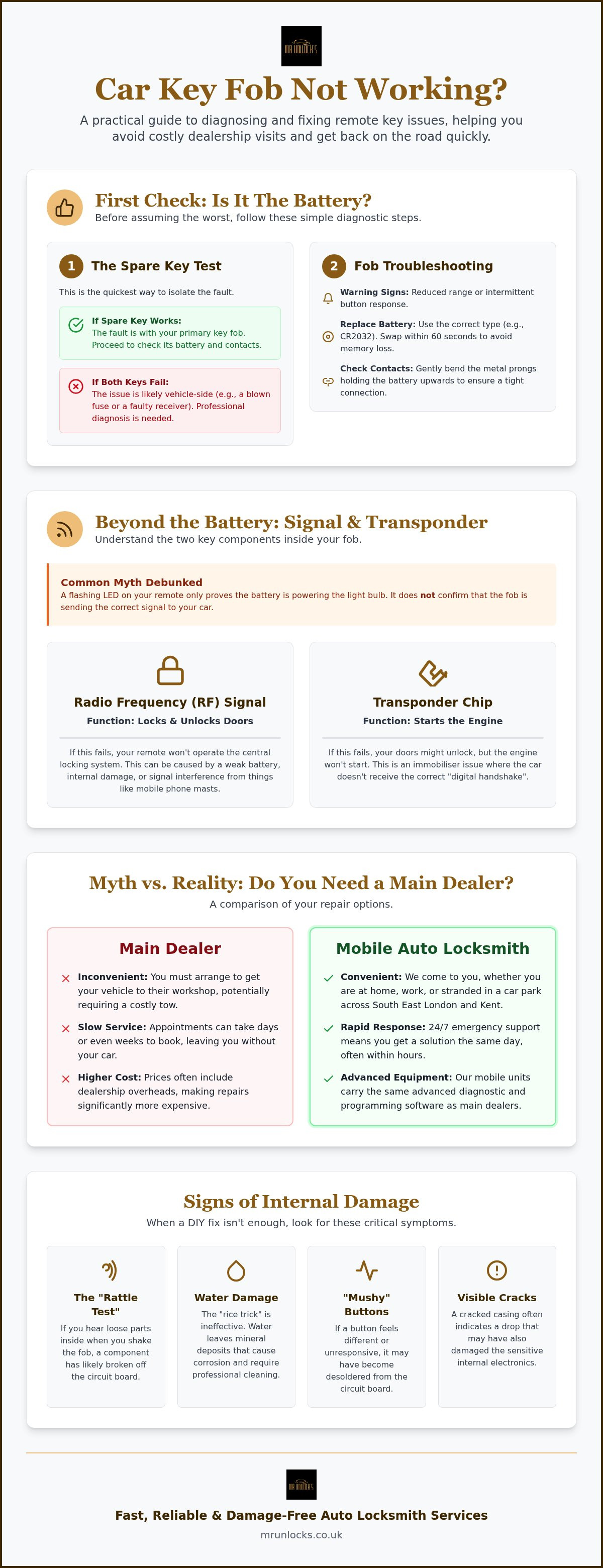
Your first instinct when facing a car key fob not working is likely to blame the battery. You're often right. A dying cell usually gives warning signs before it quits entirely. Look for a significant reduction in range; if you now have to stand right next to the driver’s door rather than clicking from across the driveway, the voltage is dropping. Intermittent response is another red flag. If you find yourself pressing the unlock button five times before the indicators flash, the battery is struggling to send a consistent signal.
Before you reach for the screwdriver, perform the spare key test. It is the fastest way to isolate the fault. If your spare key works perfectly, the issue lies within your primary fob. If both keys fail, you're likely looking at a vehicle-side issue like a blown fuse or a faulty receiver. This simple check saves you from wasting money on parts you don't need.
To open the fob, look for a small notch along the seam. Use a plastic pry tool or a coin wrapped in a thin cloth to avoid gouging the plastic. Gently twist until the two halves pop apart. Once inside, perform the "Paperclip Test" on the metal prongs that hold the battery. These contacts can flatten over time. Use a paperclip to gently bend the prongs upwards, ensuring they make a firm, tight connection with the battery surface. A loose battery is a common cause of "dead" remotes.
Choosing the Right Replacement Battery
Most modern fobs use button cells like the CR2032 or CR2025. The numbers represent the dimensions; a CR2032 is 20mm wide and 3.2mm thick. Whilst they look identical, using a CR2025 in a slot designed for a CR2032 will result in a loose connection and intermittent power. Avoid "no-name" batteries from discount centres. These often have a lower shelf life and inconsistent voltage, which can cause erratic behaviour in your car's security system. The modern Remote keyless system relies on a steady power supply to stay synchronised. Be quick with the swap; some fobs only give you 60 seconds to change the battery before they lose their internal memory and require professional reprogramming.
Cleaning Internal Contacts
If a fresh battery doesn't work, oxidation might be the culprit. Damp air can cause a thin layer of grime to build up on the circuit board. Dip a cotton bud in a small amount of surgical spirit and gently wipe the metal contact points. If you spot a button that feels "mushy" or clicks differently, it may have desoldered from the board. This requires a steady hand and a soldering iron, or a professional mobile locksmith to repair. If the fob has been dropped in water, don't rely on the rice trick. Rice does not remove the minerals left behind by water, which eventually cause corrosion. Use surgical spirit to displace the moisture and clean the board immediately.
The Science of Signal: Why Your Transponder Chip Matters
A flashing LED on your remote is a common source of confusion. Many drivers assume that because the little red light blinks, the remote must be sending a signal. This is a myth. That light only proves the battery is successfully powering the bulb, not that the internal hardware is communicating with your vehicle. If you're facing a car key fob not working despite a fresh battery, the problem usually lies with the transponder chip. This tiny, unpowered component is the silent heart of your security system. Whilst Radio Frequency (RF) signals typically handle the door locks, the transponder handles the "digital handshake" required to turn the engine over. Some older systems even utilised Infrared (IR) for ignition, where a simple smudge on the lens could prevent the car from starting.
When your car unlocks perfectly but the engine refuses to fire, you're likely experiencing an immobiliser problem. The vehicle's security computer is waiting for a specific code that the key is failing to provide. Modern Keyless Ignition Systems are particularly sensitive to these signal failures. Without that precise verification, the fuel pump or starter motor remains disabled to prevent theft. The transponder chip acts as the primary gatekeeper for the engine immobiliser, ensuring the vehicle only starts when a unique, authorised digital handshake occurs.
Signal Interference and "Dead Zones"
External environments can play havoc with your remote. High-voltage power lines, mobile phone masts, or even large radar installations at airports can create "dead zones" that jam your fob's frequency. We frequently encounter these issues in densely populated areas of South East London or near industrial centres in Kent. If your fob fails in a specific location, try the "Chin Trick." By holding the fob against your jaw, the fluid in your head acts as a makeshift antenna. This increases the signal's range and helps it punch through local interference. It sounds eccentric, but the physics of wave propagation makes it a highly effective emergency tactic.
Transponder De-synchronisation
A key can "lose its coding" for several reasons, but a flat car battery is the most frequent culprit. When the vehicle's main power drops below a certain threshold, the security module can sometimes reset, effectively "forgetting" its paired keys. Additionally, on older rolling-code systems, repeatedly pressing the buttons whilst far away from the car can cause the fob to fall out of sequence with the receiver. If your hardware has desynchronised, you don't need to pay for a recovery truck to the dealership. A mobile specialist can provide on-site key programming to get you moving again immediately.
Myth vs Reality: Do You Really Need a Main Dealer for Key Repairs?
When you discover your car key fob not working, the immediate pressure to call the dealer is immense. Most drivers believe the myth that only a dealership holds the specific software required for their vehicle’s make. This is a costly misconception. The reality is that professional mobile locksmiths invest heavily in high-end diagnostic equipment. We often carry software that is just as capable as the dealer’s, allowing for expert car key programming London wide, right at your location.
The "Dealer Wait" is a significant hurdle that many overlook until they are in a crisis. Main dealers rarely stock blank keys for every specific model on-site. They typically order them from a central hub, which leads to a frustrating 7-10 day wait whilst you remain stranded. A mobile auto locksmith provides a same-day response. Additionally, if your fob has failed completely, a dealership will require you to arrange and pay for a recovery truck to tow your vehicle to their service centre. We eliminate this hidden expense by bringing the workshop to you, whether you are at home or at work.
The Truth About "Original" vs "Aftermarket" Keys
You don't have to sacrifice quality for speed or price. Locksmiths can provide Original Equipment Manufacturer (OEM) keys that are identical to the ones sold at the showroom. For those with older vehicles, high-quality aftermarket keys offer a reliable, budget-friendly alternative. These function exactly like the original but without the premium price tag. Regardless of the shell you choose, the internal chip must be correctly transponder programmed to your vehicle. Without this precise digital setup, the key will never bypass the immobiliser.
Cost Comparison: Auto Locksmith vs Dealer
Choosing a mobile specialist is generally 30-50% cheaper than visiting a main dealer. Dealerships have massive overheads and fixed pricing structures that rarely favour the customer. They also have a habit of refusing to repair a faulty fob. If a button is loose or the casing is cracked, a dealer will almost always insist on an expensive full replacement. We take a different approach. By focusing on the specific fault, we can often repair your existing hardware or provide a new key on-site. This saves you the stress of a massive bill and the inconvenience of being without a car for a week.
Signs of Internal Damage: When DIY Fixes Aren’t Enough
A fresh battery cannot fix a shattered circuit board. If you have dropped your keys on the pavement in Lewisham or stepped on them in your driveway, physical trauma is the likely cause of your car key fob not working. Hairline fractures in the solder or the board itself often go unnoticed. These breaks interrupt the flow of electricity, rendering the remote useless despite having full power. Shake the fob. If you hear a distinct clicking or rattling sound, a critical component has likely detached from the internal board. This "Rattle Test" is a clear indicator that the hardware is compromised.
Rubber buttons also have a finite lifespan. Over years of use, the rubber can perish or stretch, meaning your physical press no longer reaches the micro-switch underneath. You might feel the button "click," but if the switch has collapsed or shifted, no signal is sent. Stop your DIY efforts if you find yourself poking at the green circuit board with metal tools. The risk of accidentally shorting out the immobiliser chip is high. If you "brick" this chip, the car will no longer recognise the key at all, turning a simple repair into a much more expensive programming job.
Damaged Induction Coils
Certain luxury vehicles, particularly older BMW and Land Rover models, use fobs that recharge whilst sitting in the ignition slot. These rely on an internal induction coil to stay powered. If this coil becomes damaged or desoldered, the key will fail to charge and eventually die. A faulty coil also prevents the car from "seeing" the key when it is inserted, meaning the engine won't start. Our car key programming near me services include roadside diagnostics that can identify these specific hardware failures without requiring a trip to a garage.
The "Emergency Blade" Solution
Most "keyless" smart fobs contain a hidden physical emergency blade. Look for a small slider or button on the casing to release it. You can use this to unlock the driver's door manually. In many modern cars, the lock barrel is hidden under a plastic cap on the door handle which you must gently pop off. Be aware that opening the door this way may trigger the alarm until the car recognises the transponder. If your transponder is physically broken, the physical key still won't start the engine. If you are stuck with a non-responsive ignition, contact Mr Unlocks immediately for a professional on-site repair.
Rapid Response: How a Mobile Auto Locksmith Saves Your Day
When you're staring at a car key fob not working in the middle of a cold night, you don't need a lecture on battery types; you need a technician at your side. Mr Unlocks operates with a high sense of urgency because we know that being locked out is a safety issue, not just an inconvenience. Our 24/7 mobile service covers South East London and Kent, ensuring that help is always available, regardless of the hour. We specialise in damage-free entry, using precision tools to bypass locks without scratching your paintwork or shattering a window. This non-destructive approach is a core part of our professional service, giving you peace of mind whilst we work.
Once we have gained access, we don't just leave you with an open car and no way to start it. Our mobile workshops are equipped to provide a full replacement car key on the spot. We cut the physical blade and programme the transponder chip while you wait, saving you the stress of a dealer visit. Knowing that a vetted, local expert is handling your security ensures that your vehicle remains safe and your day stays on track. We take pride in being the first responders for automotive lock issues, arriving ready to act with the right tools for the job.
Serving London and Kent’s Commuters
Time is critical for commuters in Lewisham, Bromley, Greenwich, and Bexley. We maintain fast response times across these areas to get you moving before your schedule falls apart. Being "mobile" is particularly vital for vehicles stuck in multi-storey car parks where a traditional recovery truck simply cannot fit. You might wonder how long car key programming takes when performed at the roadside; usually, we can have a new, fully functional key ready in under an hour. We bring the diagnostic centre to your car's location, eliminating the need for expensive towing and dealership delays.
What to Have Ready for Your Locksmith
To ensure a rapid resolution, please have your documentation ready. We require proof of ownership, typically your V5C logbook, and a valid form of photo ID. This is a vital security measure to protect your vehicle. It is also helpful to locate your Vehicle Identification Number (VIN), which is usually visible through the bottom of the windscreen or on the driver's door pillar. Having these details to hand allows us to verify the correct key profile and programming software immediately upon arrival. Contact Mr Unlocks now for 24/7 mobile assistance in London and Kent if you are currently facing a car key fob not working.
Get Back on the Road Today
Facing a car key fob not working doesn't have to mean a ruined day or a week-long wait for expensive dealership parts. We've explored how a simple battery swap is often just the beginning; true vehicle access frequently requires professional diagnostic tools to address transponder desynchronisation or hidden circuit damage. You now have the practical knowledge to bypass the "dealer-only" myth and choose a faster, mobile-first solution that saves you both time and money.
Don't stay stranded in a rainy car park or on your own driveway. We provide a 24/7 Emergency Response with a strict focus on non-destructive vehicle entry, ensuring your car stays in showroom condition whilst we work. Our mobile technicians cover the whole of London and Kent, bringing the workshop directly to your location. Get a 24/7 Mobile Locksmith Quote Now and let a local expert take the stress out of your situation. You'll be back behind the wheel and on the road sooner than you think.
Frequently Asked Questions
Why is my car key fob not working even after a battery change?
A fresh battery cannot fix a desynchronised transponder or damaged internal contacts. If the car key fob not working persists, the internal circuit board might have hairline fractures from a previous drop. Sometimes the new battery is the wrong thickness or has a protective film left on it. If cleaning the contacts with surgical spirit fails, the vehicle likely needs professional reprogramming to "re-learn" the key.
Can I still start my car if the key fob battery is dead?
Yes, most modern vehicles have an emergency backup method for this exact situation. Use the hidden physical blade inside your fob to unlock the door manually. To start the engine, hold the fob directly against the start button or a specific mark on the steering column whilst pressing the brake. These spots contain an inductive reader that powers the transponder chip wirelessly, bypassing the dead battery.
How much does it cost to fix a car key fob that is not working?
The total cost depends on whether the hardware needs a minor repair, a resynced transponder, or a full replacement. Mobile auto locksmiths are typically 30-50% cheaper than main dealers because they eliminate recovery fees and dealership markups. Always request a transparent quote that includes call-out fees and programming to avoid hidden costs. A local specialist can provide an accurate price based on your specific vehicle make.
How do I reprogramme my car key fob myself?
Manual programming is possible on some older models through a sequence of ignition turns and button presses. However, most cars manufactured after 2010 require specialist diagnostic software connected to the vehicle's OBD port. Attempting to DIY programme a modern smart key can lead to a security lockout. It is safer to use a mobile service that provides on-site programming to ensure the transponder pairs correctly with the immobiliser.
Is it possible to repair a water-damaged car key fob?
Success depends on how quickly you act to displace the moisture. Remove the battery immediately and clean the circuit board with surgical spirit to prevent corrosion. Avoid the rice trick, as it fails to remove mineral deposits that cause long-term damage. If the board has already started to corrode or short circuit, a professional can test the components, but a full replacement is often the only reliable solution.
Why does my car key fob only work when I am standing right next to the car?
Reduced range usually signals a dying battery or significant signal interference. If a new battery doesn't restore the range, the internal antenna in the fob may be loose. External factors in London and Kent, such as proximity to mobile masts or high-voltage power lines, can also jam the frequency. If your car key fob not working from a distance is a constant issue, the vehicle's receiver might be failing.
Can a locksmith fix a keyless entry "smart" fob on-site?
Yes, professional mobile locksmiths carry the same high-end diagnostic computers used by main dealers. We can gain entry to your vehicle using non-destructive methods and programme a new proximity fob at your location. This on-site service eliminates the 7-10 day wait often required by showrooms. We cut the emergency blade and pair the smart technology to your car while you wait at home or work.
What should I do if my car key fob light is flashing but the doors won’t unlock?
A flashing light proves the battery has power but does not guarantee a signal is being sent. The transponder has likely fallen out of sync with the vehicle's security module. Test your spare key first to isolate the fault. If the spare works, your primary remote requires professional resyncing. If both keys fail, the issue is likely a blown fuse or a fault with the vehicle's central locking receiver.


Comments