


Key Snapped in Car Lock? A Step-by-Step Guide on What to Do Next

It is 5:30 PM on a cold Tuesday in Bromley, and you have just heard that sickening "snap" while trying to start your engine. Half the metal blade is in your hand, whilst the other half is buried deep inside the ignition barrel. You are stuck in the car park, the rain is starting to fall, and your mind is already racing through the costs of a total lock replacement. It is a high-stress scenario that leaves most drivers feeling completely stranded and anxious about potential damage to their vehicle's delicate internal components.
We understand that a key snapped in car lock feels like a disaster, but it is actually a manageable mechanical failure. You don't need to panic or reach for the glue. This guide promises to show you how to handle the situation without ruining your barrel, highlighting the specialist extraction methods used by professionals to save you time and money. We will walk you through the immediate steps to take, explain why non-destructive extraction is your best option, and show you how to get a new key cut and programmed right on your driveway.
Table of Contents
Immediate Steps: What to Do (and Avoid) When a Key Snaps
The moment you realise a key snapped in car lock, your instinct is to fix it fast. Stop. The first sixty seconds determine whether this is a simple extraction or a £500 repair bill. Take your hand off the handle or ignition immediately. If the barrel is under tension, trying to turn it will only jam the fragment tighter against the internal wafers. You need to keep the situation stable to allow for a non-destructive recovery.
Don't attempt to push the remaining fragment back in. Many drivers think they can "mate" the two halves to turn the lock one last time. It doesn't work. Instead, you'll shove the broken tip past the reach of professional extraction tools. Assess how much of the key is visible. If the metal is flush with the face of the lock, it's a job for specialist hooks. If a portion is protruding, resist the urge to pull it with your fingers, as you'll likely lose your grip and push it further in.
Forget the superglue. It's the fastest way to ruin a lock cylinder. A tiny drop of cyanoacrylate will seep into the tumblers and seize the entire assembly. Magnets are equally useless. Most modern car keys are made of brass or nickel silver, which are non-magnetic. These "quick fixes" almost always result in the need for a total lock replacement rather than a simple extraction.
The Danger of DIY Extraction Attempts
Tweezers might look like the right tool, but they are often too thick for the narrow keyway. As you try to grip the metal, the tips of the tweezers act as a wedge, driving the fragment deeper amongst the tumblers. Once a fragment is pushed to the back of the cylinder, non-destructive extraction becomes nearly impossible. Professional tools are paper-thin and designed to bypass the fragment to hook it from behind. Household items simply cannot replicate this precision.
Securing the Vehicle Whilst You Wait
Whilst you wait for a mobile locksmith to arrive in Bromley, Lewisham, or Greenwich, focus on your safety and security. Check your other doors to ensure the vehicle is locked. If the key snapped in car lock whilst you were unlocking it, the car may still be secure. Stay in a well-lit area if you are stranded in a public car park. Use this time to gather your V5C logbook and photo ID. We need proof of ownership before we can cut or programme a new key. Having these documents ready ensures the job starts the moment we arrive at your location.
Why Car Keys Snap: Understanding Metal Fatigue and Friction
Most drivers assume a key snapped in car lock is a sudden freak accident. It rarely is. Usually, it's the final stage of a process called metal fatigue. Most automotive keys are manufactured from brass or nickel silver. These materials are chosen because they are easy to cut and kind to the internal lock wafers, but they aren't indestructible. Every time you turn that key, the metal flexes slightly. Over years of use, microscopic fractures develop at the "shoulders" or the deepest cuts of the blade where the metal is thinnest.
The UK's damp and freezing climate accelerates this breakdown. During a cold British winter, moisture inside the lock can freeze, or old oil-based lubricants can become thick and tacky. This creates massive resistance. If you're forcing a key on a frosty morning in South East London, you're applying torque to a brittle piece of metal. This stress is often worsened by heavy keyrings. If your car key is attached to a dozen other house keys and heavy fobs, that weight exerts constant downward leverage on the ignition blade whilst you drive. It’s a recipe for a snap.
Worn internal components also play a role. As the brass wafers inside your lock cylinder wear down, they may no longer align perfectly with the key's bitting. This causes the lock to "catch." If you find yourself applying extra pressure to overcome this resistance, you are actively weakening the key blade. Understanding these mechanical stresses is the first step in avoiding a lockout.
Identifying the Signs of a Weakening Key
Stop and look at your key today. Do you see hairline cracks near the plastic head? Is the blade slightly twisted when you look at it end-on? If you've developed a habit of "jiggling" the key to get the ignition to turn, the internal wafers are likely worn or the key bitting is smoothed down. These are your final warnings. Ignoring them usually leads to a call for emergency broken key extraction on a dark, rainy night. It is always cheaper to cut a spare from a healthy key than to extract a snapped one.
Lock Maintenance to Prevent Breakage
Prevention is simple but specific. Never use standard oil or WD-40 inside your car locks. These liquids attract grit and grime, eventually turning into a grinding paste that wears down the wafers. Use a dry graphite-based lubricant instead. Simply puff a small amount into the keyway and work the key in and out to distribute it. Periodically check the keyway for pocket lint or debris that could cause a blockage. If a lock feels stubborn, don't force it. A gentle clean and the right lubricant will often resolve the resistance before the metal reaches its breaking point.
DIY vs. Professional Extraction: Weighing the Risks
When a key snapped in car lock leaves you stranded, the temptation to reach for a pair of tweezers or a paperclip is immense. However, the success rate for DIY attempts on fragments buried deep inside the barrel is incredibly low. Most household items are too blunt or thick to grip the metal without exerting inward pressure. This pressure inevitably shoves the fragment past the tumblers, turning a standard extraction into a complex mechanical teardown.
Consider the financial stakes. A professional extraction service is a controlled, non-destructive process that preserves your existing lock. If you damage the internal wafers or the transponder antenna whilst poking around, you'll be forced to buy a new ignition assembly and have it recoded. This can easily cost five times more than a simple call-out. You also risk triggering the vehicle's immobiliser system. Modern security systems are sensitive; if the car detects tampering within the ignition barrel, it may lock down the ECU, leaving you with a car that won't start even if you manage to get the fragment out.
Sidewinder or laser-cut keys present an even greater challenge. These high-security blades have tracks cut into the face rather than notches on the edge. If one of these snaps, the fragment is often wedged into the lock's sidebar mechanism. Without specialist knowledge, you're more likely to snap your DIY tool inside the lock alongside the key, doubling the difficulty of the eventual professional repair.
When DIY Might Work (and When It Won't)
DIY extraction is only viable if at least 5mm of the key blade is protruding from the lock face. If you can't get a solid, immediate grip with needle-nose pliers, stop. The popular "two-needle" technique, where you try to lever the fragment out using thin pins, usually fails because it lacks the necessary grip strength. This is especially true for ignition locks, which are far more delicate than door locks. Ignitions contain complex steering lock mechanisms and electronic sensors that are easily knocked out of alignment by amateur tools.
The Value of a Mobile Auto Locksmith
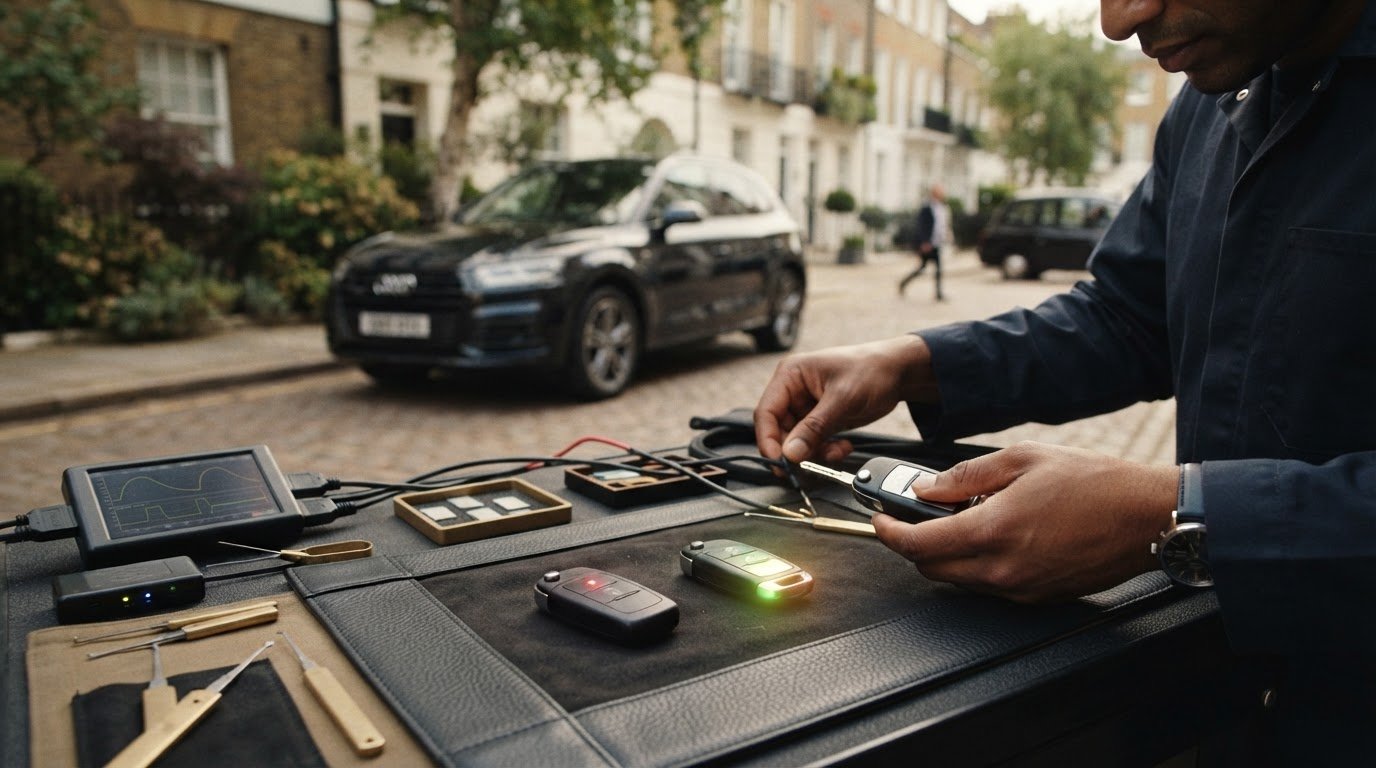
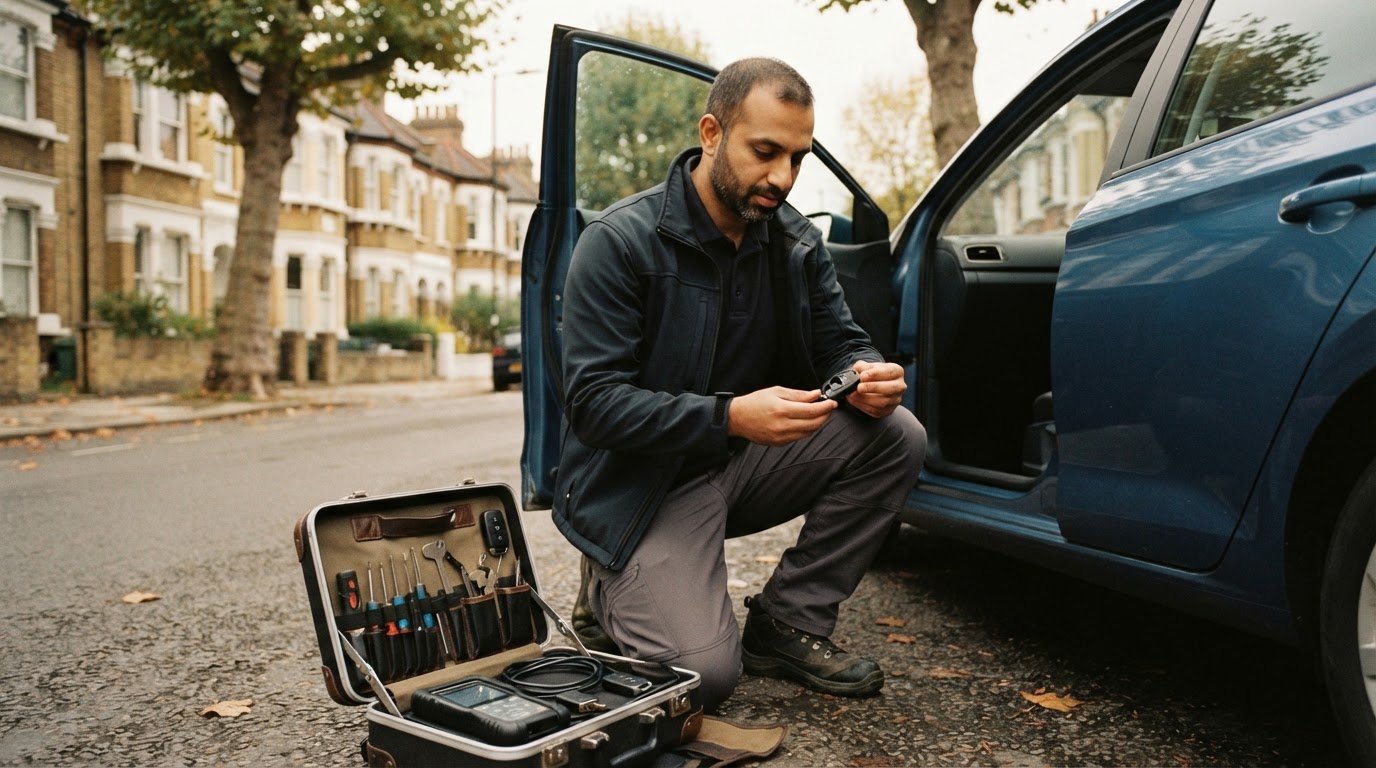
A specialist arrives with a kit designed specifically for this crisis. We use ultra-thin spiral extractors and precision hooks that can slide into the microscopic gaps between the key fragment and the lock wall. These tools allow us to bypass the fragment and pull it out from the rear without ever pushing it deeper. Because we are mobile, we can also provide a replacement car key London drivers can rely on, cut and programmed on the spot. This eliminates the need for expensive recovery trucks or dealership wait times. You get a non-destructive solution and a working key in a single visit.

How a Professional Extracts a Broken Key Without Damage
Professional extraction is a precision task. When a key snapped in car lock occurs, we don't just yank at the metal. First, we apply a specialist lubricant. This isn't your standard oil; it's a high-grade penetrant designed to slide between the stuck fragment and the internal wafers. This reduces the friction that caused the snap in the first place.
Once the fragment is lubricated, we use a thin-gauge extractor tool. These are made of high-tensile steel and are thin enough to enter the keyway alongside the broken blade. We slide the tool past the fragment to reach the bitting, the "teeth" of the key. By engaging one of these notches, we can apply outward pressure and gently "walk" the blade forward. It's a slow, methodical process that ensures no further damage to the lock's internal components.
Finally, we ensure the lock is clear of metal shavings. When a key snapped in car lock situation is resolved, it often leaves tiny brass or nickel fragments behind. If these aren't removed, they can cause the lock to jam again even with a brand-new key. We use precision tools to sweep the cylinder, leaving it in better condition than we found it.
Specialist Tools of the Trade
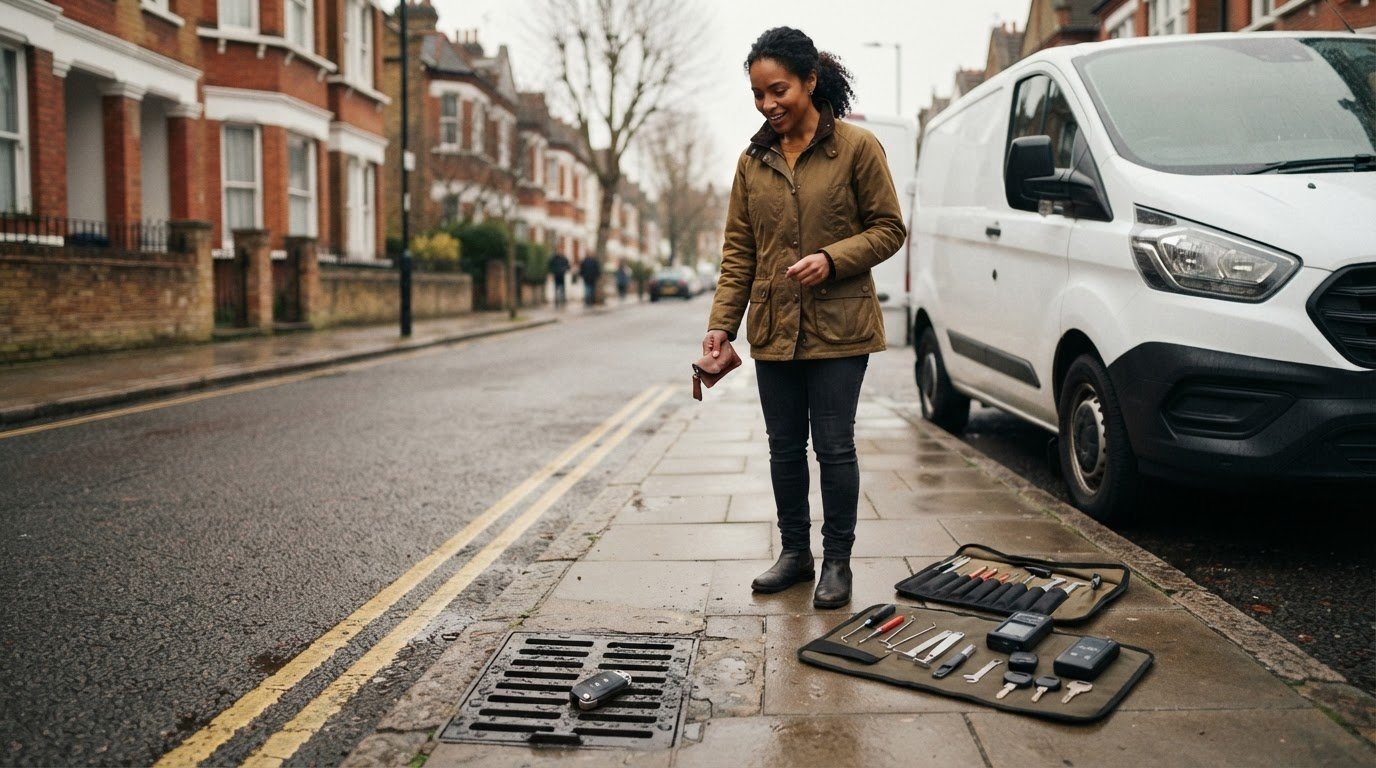
We carry a variety of extraction kits to handle different snap profiles. Spiral extractors are perfect for keys that have snapped at an awkward angle or have twisted within the barrel. They work like a miniature corkscrew, gripping the metal from multiple points. Hook extractors are our go-to for standard edge-cut blades, allowing us to catch a specific notch on the key. Once the fragment is partially visible, we use surgical-grade hemostats or miniature pliers to complete the removal without scratching the lock face.
Dealing with Snapped Keys in the Ignition
Ignition extractions are more complex because of the steering lock. If the key snapped whilst the steering was locked, there is often massive side-load pressure on the barrel. We have to carefully neutralise this tension before the fragment will budge. We also take extreme care with the electronic transponder coil, which is the plastic ring around the ignition that "talks" to your key's chip. Damaging this ring would mean the car won't start, even with a perfect key. If you need a professional to handle this delicate task, book our broken key extraction service for a guaranteed non-destructive result. We always verify that the ignition functions perfectly with a new key before we leave your site.
Organising a Replacement Key and Preventing a Recurrence
Extracting the metal fragment is only half the battle. Once your lock is clear, you're still left with a vehicle you cannot drive. Professional auto locksmiths use the extracted pieces to decode the original bitting. By measuring the depths of the cuts on the broken blade, we can replicate the exact factory specifications for a new key. This ensures the replacement works smoothly without the "notchy" feel that often precedes a mechanical failure.
A physical cut isn't enough for modern vehicles. Most cars manufactured after 1995 require car key programming London services to synchronise the new transponder chip with your car's immobiliser. Without this electronic handshake, the engine might crank but it won't start. We perform this entire process on-site, saving you the hassle and expense of a dealership visit. Once the new key is ready, we test it in every lock, including the doors and boot, to verify total functionality.
Getting a New Key Cut on the Roadside
Mobile locksmiths carry automated CNC cutting machines in their vans. These computer-controlled units provide a level of precision that manual "key-cloning" machines at a local cobbler simply cannot match. Before we begin, we require proof of ownership, such as your V5C logbook and a matching photo ID. This security compliance protects you and ensures the vehicle remains secure. For a deeper look at the technology we use, check our guide on car key cutting service London.
Long-Term Lock Health
The best way to handle a key snapped in car lock is to prevent it from happening again. If you notice your key is bending or the cuts are smoothing out, replace it immediately. It's always cheaper to cut a spare from a working key than to perform an emergency extraction. We also recommend using a "keys only" keyring for your vehicle. A heavy bunch of house keys and decorative fobs creates constant downward pressure on the ignition wafers whilst you drive. By reducing this weight, you significantly extend the life of your ignition barrel. If you feel any resistance when turning the lock, don't wait for the snap; schedule a professional lock check-up to clean and lubricate the mechanism before it fails.
Restore Your Access and Get Back on the Road
A key snapped in car lock is a high-stress moment, but it doesn't have to result in a ruined day or a massive dealership bill. By avoiding the temptation of superglue and DIY tweezers, you protect your ignition barrel from permanent damage. Remember that metal fatigue is often the hidden culprit; checking your keys for hairline cracks today can prevent a total failure tomorrow. Professional extraction is a fast, non-destructive process that keeps your vehicle's security intact whilst saving you the cost of a full lock replacement.
We are ready to respond to your emergency at any hour. Our technicians arrive with specialist tools to remove fragments and cut replacement keys on-site, ensuring you aren't left stranded in a car park or on your driveway. Key snapped in your lock? Call Mr Unlocks now for 24/7 mobile extraction across London and Kent. We provide expert non-destructive extraction and mobile key cutting on-site to get you moving again with confidence. You are only one phone call away from a professional solution.
Frequently Asked Questions
Is it possible to start a car with a snapped key still in the ignition?
No, attempting to start your engine with a broken fragment is extremely risky and usually impossible. Modern vehicles rely on a transponder chip located in the plastic head of your key. Since that head is no longer connected to the blade in the barrel, the immobiliser won't recognise the signal. You also risk jamming the metal deeper, making a professional non-destructive extraction much harder to achieve.
How much does it cost to get a snapped key extracted by a locksmith?
Costs vary based on the vehicle make, the type of key, and how deep the fragment is lodged. However, a mobile extraction service is always significantly more affordable than replacing the entire ignition assembly or paying for a dealership to install new locks. We provide transparent pricing for our mobile call-outs across London and Kent, ensuring you get a cost-effective resolution without hidden towing fees.
Can I use a magnet to pull out a broken car key?
No, magnets are completely ineffective for this task. Most automotive keys are manufactured from brass or nickel silver, which are non-magnetic materials. Trying to use a magnet is a waste of time that often leads to scratching the face of your lock or accidentally pushing the fragment further into the keyway. Professional extractors use mechanical hooks, not magnets, to retrieve the broken metal safely.
Will a locksmith need to replace my whole lock if the key snaps?
Usually, no. We specialise in non-destructive methods that preserve your existing hardware. When a key snapped in car lock is handled by a professional, we use precision tools to slide past the fragment and pull it out without damaging the internal wafers. A full lock replacement is typically only required if the lock was already mechanically failing or if a DIY superglue attempt has seized the cylinder.
What should I do if my key snaps whilst I am in South East London?
Stay with your vehicle and call Mr Unlocks for an immediate mobile response. If you are stranded in Bromley, Lewisham, or Greenwich, we can reach your location 24/7 to perform an on-site extraction. Don't try to "fish" the piece out with tweezers. Instead, gather your V5C logbook and photo ID so we can cut and programme a replacement key for you the moment the fragment is removed.
How long does it typically take to extract a broken key?
A standard extraction usually takes between 15 and 30 minutes once our technician arrives at your vehicle. If the key snapped in car lock at a particularly awkward angle or has been tampered with previously, it might take slightly longer to ensure a damage-free result. We work efficiently to get you back on the road, following up the extraction with on-site key cutting and programming if required.
Can a locksmith make a new key from the broken pieces?
Yes, we use the extracted fragments to decode the original bitting of your key. By measuring the specific depths of the cuts on the broken blade, we can use our automated CNC machines to cut a fresh, perfect replacement. This is far more accurate than trying to copy a worn key. We then programme the new transponder chip to your car's ECU to ensure the engine starts immediately.
Does insurance cover the cost of broken key extraction?
It depends on your specific insurance provider and policy details. Many comprehensive car insurance policies or premium breakdown covers include "key protection" that may reimburse you for the cost of extraction and replacement. You should check your policy documents or contact your insurer to confirm. We provide full, detailed receipts for our mobile services to help you process any potential claims with your insurance company after the job is finished.
Comments